Home Décor and Furniture: Finding Treasures at the Braderie de Lille 2027
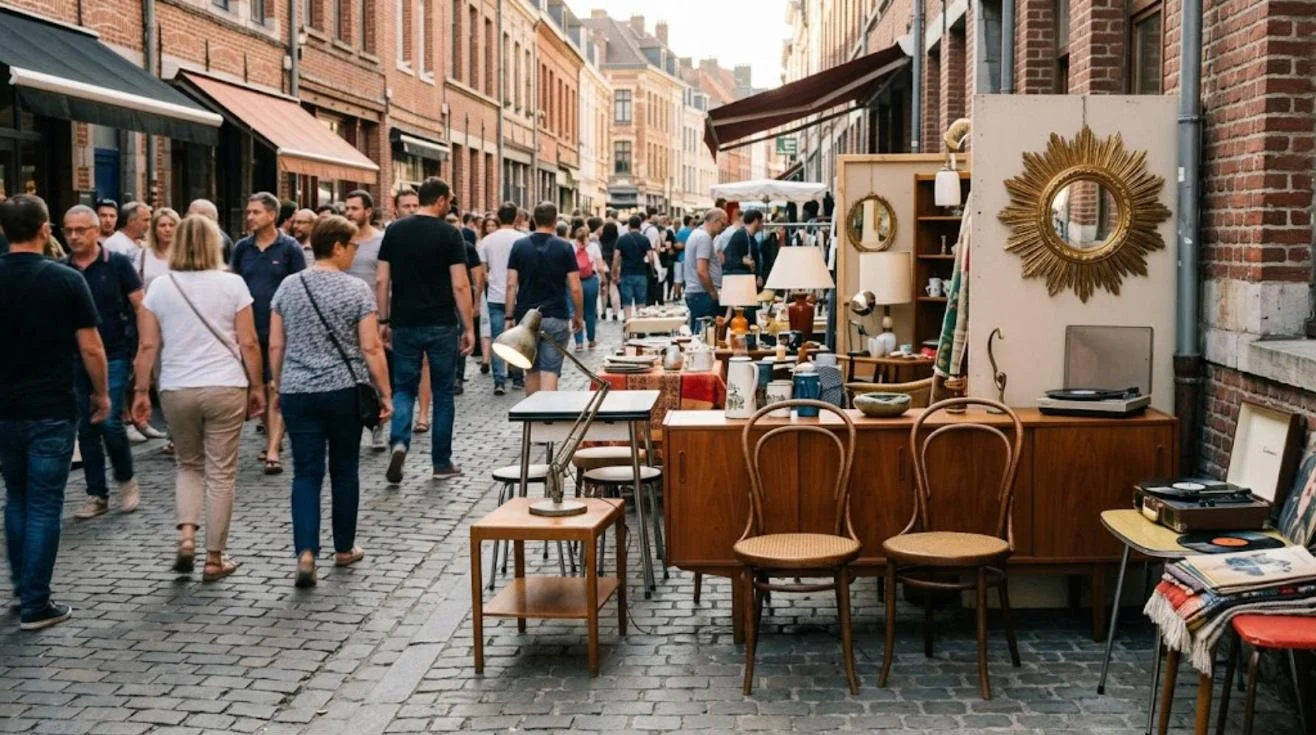
The Braderie: paradise for home décor lovers
Every year, the Braderie de Lille turns up pieces of furniture and décor that would make Parisian antique dealers jealous. From Art Deco sideboards to Thonet chairs, from gilded mirrors to industrial lamps, the Braderie perimeter is a giant showroom at friendly prices.
Vintage furniture is one of the most profitable categories for bargain hunters. A marble bistro table bought for €40 at the Braderie resells for €200 at a Parisian dealer. A leather club armchair haggled down to €80 is easily worth €400 in a shop. But beyond the potential profit, it is the pleasure of furnishing your home with one-of-a-kind pieces that draws décor enthusiasts.
Styles to look out for in 2027
Industrial furniture remains a safe bet. Old trade furniture (workshop lockers, carpenters’ workbenches, factory stools, workshop lamps) can still be found at reasonable prices at the Braderie. The Vieux-Lille and rue Royale are the best spots for this style.
Mid-century modern (1950s to 1970s) is enjoying growing popularity. Teak coffee tables, moulded plastic chairs, Scandinavian sideboards, arc lamps: the design of this era is timeless and fits into any interior. Be warned that prices are rising, as sellers know the value of these pieces.
Country chic still has plenty of fans. Odd earthenware crockery, embroidered tablecloths, gilded wooden frames, antique mirrors, small patinated pieces of furniture: the Braderie is full of the rustic treasures that interiors magazines fight over.
Brutalism and the 1980s are making a big comeback. Smoked-glass furniture, chrome metal shelving, halogen lamps, ceramic objects in geometric shapes: postmodernism is on trend, and the Braderie is full of pieces their owners still consider « ugly ».
The best neighbourhoods for décor
The Vieux-Lille has the greatest concentration of fine antique furniture and antiques. Prices reflect that, but quality and authenticity are there too. This is where you will find period furniture (Louis XV, Louis XVI, Empire), antique mirrors and silverware.
The Moulins and Saint-Sauveur area is the territory of affordable design. Younger sellers offer 1960s to 1980s furniture at prices that are still reasonable. It is also where you find vintage Ikea furniture. Yes, Ikea’s first collections from the 1990s are becoming collectable.
Wazemmes is paradise for characterful furniture at low prices. Residents empty entire houses, and you can find solid oak sideboards for €50, farmhouse tables for €30 and bistro chairs for €5 each. The value for money is unbeatable.
How to get furniture home from the Braderie
The main challenge when buying furniture at the Braderie is transport. You cannot drive into the perimeter, and carrying a sideboard for 2 kilometres is not an option.
There are several solutions:
Negotiate delivery. Many professional sellers offer to deliver your purchases after the Braderie, for an extra €20 to €50 depending on the distance. This is the most comfortable solution.
Come back with a vehicle. The Braderie ends on Sunday in the late afternoon. If you spot a piece on Saturday, agree the price and ask the seller to set it aside. Come back on Sunday evening or Monday morning with a car to collect it.
Use a sack truck or a trolley. For small pieces (chairs, side tables, stools), a folding trolley will do the job. Also bring straps and blankets to protect your purchases in transit.
How to spot a quality piece of furniture
Solid wood can be recognised by its weight (a solid wood piece is heavy), its edges (the grain is visible) and its sound (tap the surface: solid wood sounds full, melamine sounds hollow).
Traditional joints, such as mortise and tenon or dovetails, indicate quality craftsmanship. Joints made with screws or staples are a sign of more recent industrial manufacture.
The condition of the structure matters more than looks. A piece with attractive veneer but a wobbly frame is a poor investment. Conversely, a sturdy piece with a damaged surface is easy to restore: a sanding, a coat of varnish or paint, and it comes back to life.
Brands and signatures. Some furniture carries manufacturers’ stamps (underneath, behind drawers, under tabletops). Brands such as Roche Bobois and Ligne Roset, or Scandinavian designers (Jacobsen, Wegner, Panton), add real value to a piece.
Club armchairs and vintage furniture: the pieces to look for
The club armchair, which appeared in the early 20th century, remains one of the most sought-after pieces: patinated leather or velvet, traditional or more streamlined models. You will also find plenty of upcycled or customised furniture, which blends well with a modern, industrial, bohemian or Scandinavian interior.
Choosing and looking after vintage furniture
- check the structure (legs, joints, drawers) and make sure there are no woodworm holes in the wood;
- for an armchair, test the seat and look at the condition of the leather at the seams and armrests;
- once home, feed the leather and wood with suitable products;
- plan the transport: a piece of furniture will need to be carried to your vehicle, outside the pedestrian perimeter.
Budget and haggling
Furniture prices at the Braderie vary enormously. A private individual clearing out their house before moving will sell a 1950s sideboard for €30. A professional dealer will offer the same piece for €150. The difference is the context, the pitch and the seller’s know-how.
For furniture, haggling works particularly well on Sunday afternoon. A seller who has to pack up an 80 kg sideboard will be highly motivated to give you a price. At 3 pm on Sunday, the magic phrase is: « How much to take that off my hands? » (in French, « Je vous débarrasse de ça pour combien ? »). The wording matters: you are not buying a piece of furniture from them, you are doing them a favour.
To prepare your décor hunt, see the Braderie map, the practical information and the guide to getting around.