History of the Braderie de Lille Since 1127
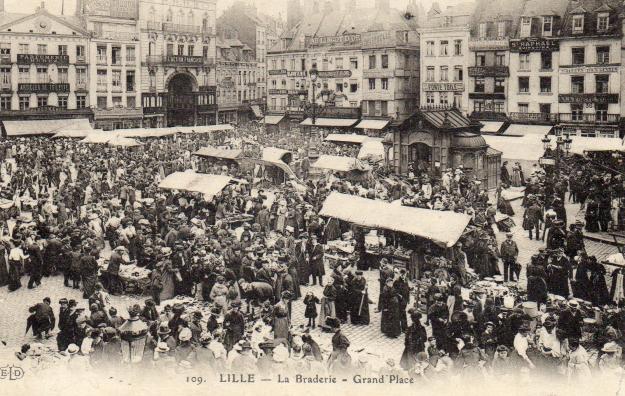
The history of the Braderie de Lille is not well documented: the first written record dates from 1127. The Braderie has changed many times, in its principle (fair, cloth sale, flea market), in the date on which it was held and in its length.
In the Middle Ages, in the 12th century, servants obtained the right to sell their masters’ old objects and clothes once a year. This custom overlapped with the Lille fair, where locals and foreigners alike could freely sell their goods.
At the end of the 15th century, this fair was extended by two days. 1523 is an important date: the Braderie de Lille then began on 30 August (or 31 August if the 30th fell on a Sunday) and its length was set at seven working days. It was also during this century that the “bradeux” (the people who sell at the Braderie) in the modern sense of the word appeared, in the form of servants who sold their employers’ old objects (keeping the money for themselves). As they had to be back in time to serve their masters when they woke up, it is easy to see why the items were “bradés” (sold off cheaply) so that they would sell faster.
During the 14th century, middle-class townspeople, followed by pedlars from outside Lille, also came to sell their goods. In 1873, a chronicler noted that the spirit of the braderie was fading. Between the end of the 19th century and the beginning of the 20th century, chips (frites) made their appearance (the mussels only came later). Then, from the middle of the 20th century to the 1960s, the Braderie de Lille became a large market of little interest, because of the wars and post-war reconstruction. In the 1970s, with the growing criticism of consumer society, the braderie was reborn.
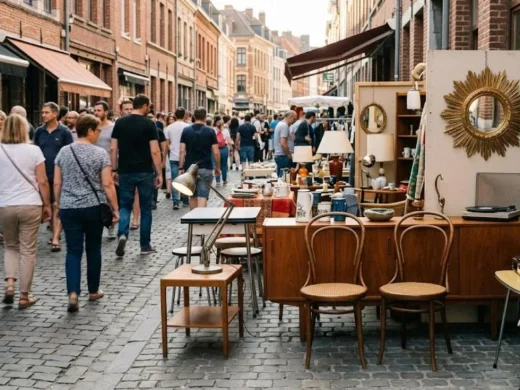
Today, the Braderie stretches over 53 km of stalls and welcomes more than 2.5 million people (2026 figures from the City of Lille). It is generally held on the weekend of the first Sunday in September. In 2026 it ran non-stop from Saturday 8 am to Sunday 6 pm (34 hours); these 2026 hours are the latest known, and the dates announced by the City of Lille for 2027 are Saturday 4 and Sunday 5 September. Between the late 1940s and the late 1970s, the braderie ran from midnight on Sunday to midday on Monday, and was held on the first Monday after the first Sunday in September. The night was then reserved for the bradeux, while the shopkeepers’ braderie took place on Monday morning. Today, the braderie takes place over the weekend. During this time, the city of Lille turns into an enormous “flea market” where cultures mix. Many activities (concerts, the Foire aux Manèges funfair, the children’s Braderie and more) also accompany the event.
The Braderie de Lille tradition has endured through the centuries, despite Lille’s turbulent past: the city was often at war and changed hands (successively Flemish, French, Burgundian and Spanish before finally becoming French again).
The continuity of the Braderie over the centuries also shows Lille to have been an essential trading centre throughout history.
The editions that marked the history of the Braderie
- 1882: the people of Lille dressed in 18th-century fashion to recreate a painting by François Watteau devoted to the Braderie.
- 1945: the first post-war Braderie was held… without mussels, because of rationing.
- 1981: Pierre Mauroy, Mayor of Lille, became Prime Minister; the Braderie gained national visibility on television.
- 1996: the Braderie moved from Sunday-Monday to Saturday-Sunday.
- 2011: torrential rain and 90 km/h gusts forced exhibitors to pack up in a hurry on Saturday evening.
- 2016: the Braderie was cancelled for security reasons, a few weeks after the Nice attack.
- 2020 and 2021: cancellations due to the Covid-19 pandemic, before the Braderie returned in 2022.
For figures and records (attendance, moules-frites, exhibitors), see our page the Braderie de Lille in numbers.